
Potential customers are bombarded with thousands of brand messages every single day. This means that gaining their attention is all about standing out. The brands that win build their entire go-to-market motion on a clear positioning foundation.
This comprehensive guide to positioning strategies walks you through everything you need to know about marketing positioning. You’ll find out about core definitions and classical models to real-world examples and a practical framework you can start applying right now.
Contents
What Is Marketing Positioning, and Why Does It Matter?
The STP Framework: Segmentation, Targeting and Positioning
Step-by-Step: How to Define Your Corporate Positioning
Proven Positioning Strategies to Differentiate Your Brand
Applying Positioning Strategies in Your Organisation: A Quick Framework
Final Thoughts: Marketing Positioning is an essential differentiator
What Is Marketing Positioning, and Why Does It Matter?
Marketing positioning is the strategic process of defining how your brand, product, or service occupies a distinct place in the minds of your target customers relative to competitors. It answers one deceptively simple question:
| Core Question: “Why should my ideal customer choose me over every other option available to them?” |
Brand positioning isn’t your tagline, logo, or product features. Positioning is the mental real estate you occupy and some of the associations that people form with your brand
Why Brand Positioning Is the Foundation of Brand Strategy
Strong brand positioning creates advantages across your entire marketing system:
- Messaging clarity: Every piece of content, ad, or sales deck pulls in the same direction
- Pricing power: A well-positioned brand commands premium prices because customers perceive unique value
- Sales efficiency: When prospects already understand what you stand for, sales cycles shorten
- Resilience: Positioned brands weather competitive pressure and market downturns better than undifferentiated ones
The STP Framework: Segmentation, Targeting and Positioning
Before you can position your brand effectively, you must know who you’re positioning for. This is why the STP model (Segmentation, Targeting, and Positioning) is essential. STP marketing creates a logical sequence from market understanding to brand differentiation.
Segmentation
Market segmentation divides your total addressable market into distinct groups of customers who share similar needs, behaviors, or characteristics. Common segmentation dimensions include:
- Demographic: Age, income, job title, company size (B2B)
- Geographic: Region, country
- Psychographic: Values, lifestyle, risk appetite
- Behavioural: Purchase frequency, brand loyalty, usage patterns, buying triggers
- Firmographic (B2B): Industry vertical, revenue band, headcount, tech stack
Targeting
Not every segment is worth chasing. Targeting is the process of evaluating segments against three criteria and choosing where to compete:
- Attractiveness: Is the segment large enough and growing? Does it have sufficient purchasing power?
- Fit: Does your product solve this segment’s core problem better than alternatives?
- Accessibility: Can you reach this segment cost-effectively through owned, earned, or paid channels?
The output of targeting is a clearly defined Ideal Customer Profile (ICP): the customer for whom your solution delivers the highest value.
Positioning
Once you’ve defined your target segment, positioning enables you to influence that segment’s perception of your brand. Every visual, verbal, and experiential element of your brand should reinforce the single most important thing you want customers to believe about you.
| STP in one line: Segmentation identifies who exists in the market. Targeting chooses who you serve. Positioning defines why they should choose you. |
Step-by-Step: How to Define Your Corporate Positioning
Effective positioning is built through a structured discovery process. Below is a proven five-step approach used across industries:
| Step 1: Audit Customer Reality | Interview 10–15 current customers. Ask what problem they were trying to solve when they found you, what alternatives they considered, and what made them choose you. Mine reviews, NPS verbatims, and support tickets for recurring language. |
| Step 2: Map Competitive Alternatives | List every realistic alternative your target customer has: direct competitors, indirect substitutes, and the ‘do nothing’ option. Identify where each competitor stakes its claim in the market. |
| Step 3: Identify Your Differentiated Value | Cross-reference what customers value most against what competitors deliver poorly. The overlap is your differentiation zone: the ground only you can credibly own. |
| Step 4: Write a Positioning Statement | Synthesise your findings into a single internal positioning statement (see template below). This is a strategic compass for internal alignment. |
| Step 5: Validate & Iterate | Test your positioning with target customers through messaging experiments (landing page A/B tests, ad copy tests, sales narrative trials). Refine based on conversion and resonance data. |
The Positioning Statement Template
Use this classic structure to articulate your positioning clearly:
| For [target customer] who [has this need or problem], [your brand] is the [market category] that [delivers this benefit] because [reason to believe / proof point]. Unlike [primary alternative], we [key differentiator]. |
Proven Positioning Strategies to Differentiate Your Brand
Perceptual Mapping
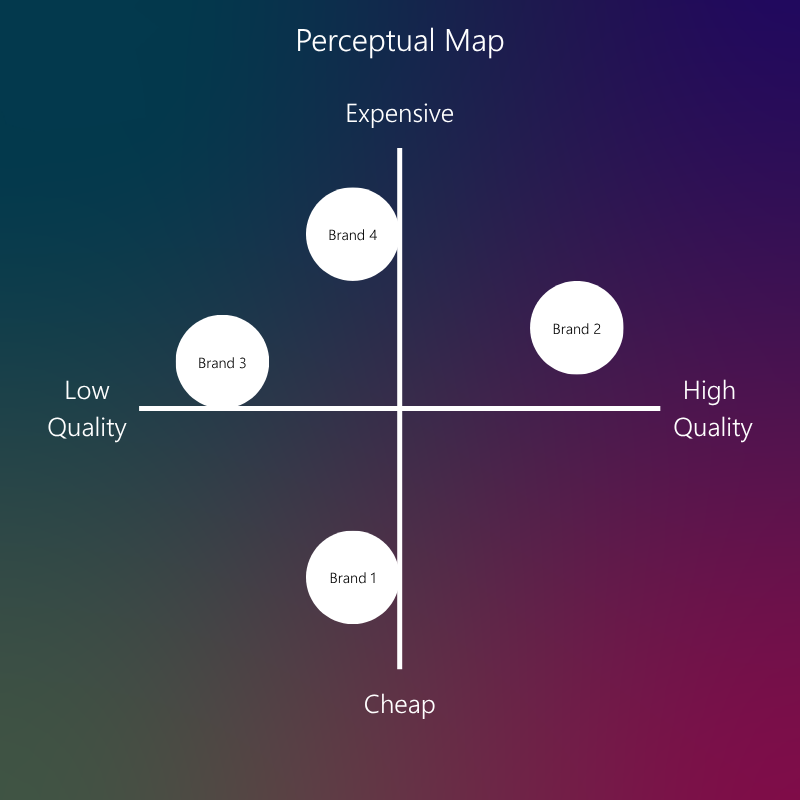
A perceptual map is a two-axis grid that plots your brand and competitors against two attributes that matter most to your target customers (e.g., Price vs. Quality, or Innovation vs. Reliability). The goal is to identify areas of high customer desire with low competitive density. You can then use marketing positioning to own that space.
To build an effective perceptual map:
- Survey your target customers on the relative importance of 6–8 attributes
- Ask them to rate each competitor on those same attributes.
- Plot the results
- Look for clusters (overcrowded spaces to avoid) and gaps (underserved positions to capture).